
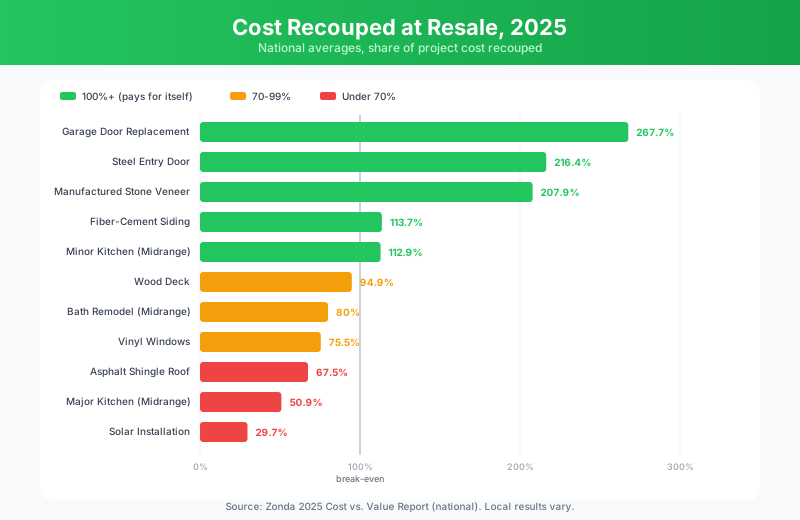
Planning a home improvement? Stop. Before you spend a dime, you need to know which projects tend to pay you back at resale and which will leave you underwater. This guide uses the national averages from Zonda's 2025 Cost vs. Value Report to show how much of each project's cost typically comes back when you sell.
The ROI Reality Check
Most remodeling projects do not pay for themselves at resale. In the 2025 Cost vs. Value national data, the share of cost recouped ranges from 267.7% for a garage door replacement down to 18% for an upscale primary suite addition. The difference between a smart project and an expensive lesson is knowing which is which.
Understanding ROI Calculations
Cost Recouped (the figure Cost vs. Value reports): Cost Recouped = Resale Value Added ÷ Project Cost × 100
Net ROI: ROI = (Resale Value Added - Project Cost) ÷ Project Cost × 100
Illustrative example (not real averages):
- Kitchen remodel cost: $50,000
- Value added to home: $35,000
- Cost recouped: 35,000 ÷ 50,000 = 70%
- Net ROI: (35,000 - 50,000) ÷ 50,000 = -30%
A project "pays for itself" only when cost recouped is above 100%.
Critical Factors Affecting ROI:
- Local market conditions
- Home's current condition
- Quality of work
- Neighborhood standards
- Time until sale
Projects That Recouped More Than 100% (2025 National Averages)
All cost, value and recoup figures below are national averages from Zonda's 2025 Cost vs. Value Report. Your local numbers will differ.
1. Garage Door Replacement
Average Cost: $4,672 Resale Value Added: $12,507 Cost Recouped: 267.7%
Why It Works:
- Massive curb appeal boost
- Low maintenance appeal
- Universal buyer appeal
Maximize ROI:
- Choose insulated doors
- Match architectural style
- Add smart technology
- Include professional installation
2. Entry Door Replacement (Steel)
Average Cost: $2,435 Resale Value Added: $5,270 Cost Recouped: 216.4%
Smart Upgrades:
- Smart lock compatibility
- ENERGY STAR rating
- Decorative glass
- Matching storm door
3. Manufactured Stone Veneer
Average Cost: $11,702 Resale Value Added: $24,328 Cost Recouped: 207.9%
Why It Works:
- Dramatic curb appeal
- Low maintenance
- Weather resistance
- Timeless aesthetic
Best Applications:
- Front entry accent
- Foundation covering
- Chimney enhancement
- Garage front detail
4. Siding Replacement (Fiber Cement)
Average Cost: $21,485 Resale Value Added: $24,420 Cost Recouped: 113.7%
Why Fiber Cement:
- Fire resistance
- Termite resistance
- Long service life
- Paint holds longer
5. Minor Kitchen Remodel (Midrange)
Average Cost: $28,458 Resale Value Added: $32,141 Cost Recouped: 112.9%
What's Included:
- Cabinet refacing/painting
- New countertops
- Updated backsplash
- New appliances
- Fresh paint
Skip These:
- Moving plumbing
- Changing layout
- Super high-end appliances
- Exotic materials
Projects That Recouped 70% to 100%
6. Siding Replacement (Vinyl)
Average Cost: $17,950 Resale Value Added: $17,313 Cost Recouped: 96.5%
When It Pays:
- Faded, cracked or damaged existing siding
- Homes where the exterior looks dated next to neighbors
- Owners who want low-maintenance cladding
7. Backup Power Generator
Average Cost: $13,534 Resale Value Added: $12,902 Cost Recouped: 95.3%
When It Pays:
- Areas with frequent storm-related outages
- Homes with sump pumps or medical equipment
- Buyers who work from home
8. Deck Addition (Wood)
Average Cost: $18,263 Resale Value Added: $17,323 Cost Recouped: 94.9%
ROI Boosters:
- Built-in seating
- Lighting integration
- Direct house access
- Privacy features
- Proper sizing (not too large)
A composite deck cost more on average ($25,096) and recouped 88.5%.
9. Bathroom Remodel (Midrange)
Average Cost: $26,138 Resale Value Added: $20,915 Cost Recouped: 80%
Focus Areas:
- Update fixtures
- New vanity
- Tile shower/tub
- Improved lighting
- Better ventilation
10. Window Replacement (Vinyl)
Average Cost: $22,073 Resale Value Added: $16,657 Cost Recouped: 75.5%
When It Pays:
- Single-pane to double-pane
- Broken seal replacement
- Energy efficiency focus
- Noise reduction needs
Wood windows cost more ($26,781) and recouped 70.1%.
11. HVAC Conversion (Electrification)
Average Cost: $19,484 Resale Value Added: $14,053 Cost Recouped: 72.1%
Best Returns:
- Replacing an aging fossil-fuel system with a heat pump
- Adding cooling where none exists
- Pairing the upgrade with air sealing and duct repair
- Smart thermostat inclusion
12. Basement Remodel
Average Cost: $52,012 Resale Value Added: $36,905 Cost Recouped: 71%
Make It Count:
- Fix moisture problems first
- Add egress where required by code
- Keep the layout flexible (family room, guest space, office)
Projects That Recouped Less Than 70%
13. Roof Replacement (Asphalt Shingles)
Average Cost: $31,871 Resale Value Added: $21,501 Cost Recouped: 67.5%
Value Adds:
- Architectural shingles
- Ridge vents
- Ice barriers (cold climates)
- Extended warranties
A metal roof cost more on average ($51,865) and recouped 50.1%. A roof that is near the end of its life can still be worth replacing before a sale, because buyers and inspectors focus on it.
14. Major Kitchen Remodel
Midrange: $82,793 cost, $42,130 value added, 50.9% recouped Upscale: $164,104 cost, $58,561 value added, 35.7% recouped
Why Lower Than Minor:
- Diminishing returns
- Personal taste issues
- Over-improvement risk
- Longer project time
15. Primary Suite Addition
Midrange: $170,517 cost, $55,097 value added, 32.3% recouped Upscale: $351,613 cost, $63,136 value added, 18% recouped
Consider Instead:
- Converting existing space
- Finishing a basement
- Updating the existing primary suite
- Adding a bathroom only (a midrange bathroom addition recouped 53.3%)
Projects the Report Doesn't Track
Cost vs. Value does not cover swimming pools, home office additions or sunrooms, so there is no comparable national recoup figure for them. Treat them as lifestyle purchases:
- Swimming pools: Value depends heavily on climate and neighborhood. In cold climates and family neighborhoods, many buyers see a pool as a maintenance and insurance burden.
- Home offices: Converting an existing room is usually cheaper than adding space, and a flexible room appeals to more buyers than a highly customized one.
- Sunrooms: A three-season room, covered patio, screened porch or deck with a pergola can deliver similar enjoyment for less.
The Neighborhood Factor
Avoiding Over-Improvement
Rule of Thumb: Treat the top of your neighborhood's recent sale prices as a practical ceiling for your home's value.
Illustrative example:
- Highest recent comparable sale: $460,000
- Your home value today: $380,000
- Room to add value: about $80,000
- Because most projects recoup less than they cost, the spending needed to close that gap will usually be higher than $80,000, so plan conservatively.
Market-Specific ROI Variations
Cost vs. Value publishes regional tables alongside the national averages, and the gap between regions can be meaningful for the same project. In general:
Strong-demand markets:
- Buyers compete for updated homes
- Curb appeal and move-in-ready condition carry more weight
Stable markets:
- Most suburban areas
- Mid-sized cities
- Established neighborhoods
Soft markets:
- Declining areas
- Oversupplied markets
- Economic downturns
- Expect returns below the national averages
Energy Efficiency: Resale Value vs. Bill Savings
Solar Panels
Average Cost (2025 Cost vs. Value): $55,937 Resale Value Added: $16,625 Cost Recouped: 29.7%
Things to Know:
- Bill savings depend on your utility rates, roof orientation and system size, so get a site-specific estimate
- The federal Residential Clean Energy Credit (25D) is no longer available for expenditures made after December 31, 2025, under the One Big Beautiful Bill Act (IRS); check your state and utility for any remaining incentives
- Leased systems can complicate a sale, so keep the contract with your home records
Insulation and Air Sealing
Cost vs. Value no longer tracks insulation, so there is no current national resale figure. The payoff shows up mainly in comfort and bills: ENERGY STAR says sealing air leaks and adding insulation can provide up to a 10% savings on annual energy bills.
Hidden Values:
- Comfort improvement
- Less strain on HVAC equipment
- Noise reduction
The federal Energy Efficient Home Improvement Credit (25C) also ended for property placed in service after December 31, 2025 (IRS).
Smart Home Technology
Cost vs. Value does not track smart home upgrades. They are relatively inexpensive, and some buyers like them, but don't count on getting the full cost back at sale.
Buyer Appeal Factors:
- Security systems
- Smart thermostats
- Video doorbells
- Automated lighting
Project Timing Strategy
When to Invest
5+ Years Before Selling:
- Major systems (HVAC, roof)
- Energy efficiency
- Structural repairs
- Landscaping maturation
2-5 Years Before Selling:
- Kitchen updates
- Bathroom remodels
- Flooring replacement
- Exterior improvements
6 Months Before Selling:
- Fresh paint
- Curb appeal
- Minor repairs
- Deep cleaning
Never Right Before Selling:
- Pool installation
- Luxury upgrades
- Highly personal choices
- Major additions
Cost-Saving Strategies
Value Engineering
Kitchen Savings:
- Paint or reface cabinets instead of replacing them
- Consider butcher block or laminate instead of stone counters
- DIY a tile backsplash if you have the skills
- Keep appliances and sinks in their current locations
Bathroom Savings:
- Refinish the tub instead of replacing it
- Refresh the vanity instead of buying new
- Choose standard tile over custom
- Keep plumbing locations
Each of these usually costs a fraction of the full-replacement option, though actual savings depend on your materials and contractor quotes.
Phased Improvements
Year 1: Safety and systems Year 2: Energy efficiency Year 3: Kitchens and baths Year 4: Curb appeal Year 5: Final touches
Financing Your Improvements
Best Funding Sources
Home Equity Line of Credit (HELOC):
- Pros: Usually lower rates than unsecured loans; interest may be deductible when the funds improve the home (confirm with a tax professional)
- Cons: Variable rates, home at risk
- Best for: Large projects
Cash-Out Refinance:
- Pros: Fixed rate, one payment
- Cons: Closing costs, higher balance
- Best for: Multiple projects
Personal Savings:
- Pros: No interest, no risk
- Cons: Depletes reserves
- Best for: Smaller projects
ROI Impact of Financing
Illustrative example (hypothetical numbers):
- A $30,000 project adds $25,000 in resale value
- Paid in cash: 25,000 ÷ 30,000 = about 83% of cost recouped
- Financed, with $4,000 in interest paid before you sell: 25,000 ÷ 34,000 = about 74% recouped
The higher the interest rate and the longer you carry the balance, the more financing eats into your return. Always factor financing costs into ROI calculations!
Regional ROI Variations
National averages hide real regional differences. The 2025 Cost vs. Value Report publishes separate tables for each region, and the same project can recoup noticeably more or less than the national figure depending on where you live. Look up your region's table before you commit, and pair it with what local agents see buyers paying for.
Regional priorities also differ:
- Hot, storm-prone areas: Hurricane resistance and outdoor living
- Cold climates: Insulation, efficient heating and ice protection
- Historic areas: Preservation and quality craftsmanship
- Value-conscious markets: Practical improvements and maintenance over luxury
Red Flags: Improvements to Avoid
Projects That Rarely Pay Back
Swimming Pool (Cold Climates):
- High upfront cost
- Maintenance burden
- Insurance increase
- Limited use season
Over-Personalization:
- Bold color choices
- Converted garages
- Unusual layouts
- Niche features
- Religious additions
DIY Disasters:
- Unpermitted work
- Substandard quality
- Code violations
- Visible mistakes
- Incomplete projects
Your ROI Maximization Checklist
Before Starting Any Project:
Research Phase:
- [ ] Check neighborhood comps
- [ ] Get 3-5 contractor quotes
- [ ] Calculate true ROI with financing
- [ ] Consider alternative options
- [ ] Review local permit requirements
Decision Framework:
- [ ] Will you stay 3+ years?
- [ ] Does neighborhood support value?
- [ ] Is this fixing or improving?
- [ ] Can you afford quality work?
- [ ] Will this date quickly?
Execution Strategy:
- [ ] Hire licensed professionals
- [ ] Get proper permits
- [ ] Document before/after
- [ ] Keep all receipts
- [ ] Maintain warranties
The Bottom Line
The best ROI comes from improvements that:
- Fix problems rather than add luxuries
- Appeal broadly rather than personally
- Enhance efficiency not just aesthetics
- Match neighborhood standards
- Use quality materials and labor
Remember: The highest ROI improvement is often the one that prevents expensive repairs. A modest roof repair that stops a leak before it causes major water damage can be worth far more than any cosmetic upgrade.
Your Next Steps
- Assess your home honestly
- Identify needed repairs first
- Calculate your improvement budget
- Choose projects that rank high in the Cost vs. Value data for your region
- Get multiple quotes
- Factor in your timeline
- Execute with quality
Smart improvements aren't about spending the most—they're about investing wisely. Use this guide to make decisions that enhance both your enjoyment and your equity.
Your home is more than an investment—it's where you live. Balance ROI with quality of life, but always know the numbers before you commit. Here's to improvements that pay you back!