
The short answer: you need enough home insurance to cover the full replacement cost of your home — what it would cost to rebuild from scratch at today's labor and material prices. That number is almost never the same as your home's market value, your mortgage balance, or your county tax assessment. Get it wrong and you'll either pay for coverage you don't need, or face a brutal shortfall after a total loss.
This guide walks you through every coverage type on a standard homeowners policy, the math behind each one, the common ways homeowners end up underinsured, and how to land on the right number in under ten minutes. When you're ready to crunch your specific numbers, our free home insurance coverage calculator does the math instantly.
Replacement Cost Is the Number That Matters
Most homeowners price coverage off the wrong anchor. Three numbers that are not the right answer:
- Market value — includes the land, which doesn't burn down. You're insuring the structure, not the lot.
- Purchase price — reflects when you bought, not what it costs to rebuild today.
- Mortgage balance — your lender's exposure, not yours. Underinsuring to match the loan is the single most common mistake.
Replacement cost is the cost to rebuild your home using similar materials, with current labor rates and current code requirements. It's a forward-looking, all-cash number.
A Worked Example
A 2,500 sq ft home in a Midwest suburb:
- Market value: $525,000 (includes land)
- Land value: $95,000 (per county assessor)
- Structure replacement cost at $185/sq ft: $462,500
In this case, dwelling coverage should anchor to $462,500, not the $525,000 market value. Insuring for the full market value overpays; insuring for the mortgage balance (often $300k–$400k on this home) leaves a six-figure gap.
Replacement cost per square foot varies widely — $125 to $400+ depending on region, finish level, and home age. Older homes with custom features cost more to rebuild than new construction of the same size. Talk to a local builder or use a replacement-cost estimator before locking a number.
The Six Coverages on a Standard Policy
A typical HO-3 homeowners policy bundles six coverages. You set the dwelling number; the others scale from it (or you set them separately).
1. Dwelling Coverage (Coverage A)
The structure itself — walls, roof, foundation, built-ins. Anchor this to full replacement cost, not market value.
Quick formula: square footage × local cost per square foot × adjustments for basement (+10–15%), pool (+5%), custom features, and current code upgrades.
2. Other Structures (Coverage B)
Detached structures: garage, shed, fence, driveway, in-ground pool. Default is usually 10% of dwelling coverage. Raise it if you have a detached garage, workshop, or expensive landscaping.
3. Personal Property (Coverage C)
Everything inside your home — furniture, electronics, clothing, kitchenware. Default is 50–70% of dwelling, according to the Insurance Information Institute.
This is where most people are dramatically underinsured. You're insuring what it would cost to replace every item, not what you paid for it. The only way to know the real number is to inventory your home. We built a home inventory system specifically to make this easy, and we have a step-by-step guide on documenting your home for insurance claims.
Sub-limits to watch. Standard policies cap categories: jewelry usually $1,500–$2,500, firearms $2,500, business equipment $2,500, cash $200. If you own anything that exceeds these, you need a scheduled personal property endorsement (a "rider") for that specific item.
4. Loss of Use (Coverage D)
Pays for hotels, rentals, and added living expenses while your home is uninhabitable. Many policies set it at about 20% of dwelling (Insurance Information Institute), though some insurers instead cover a set period of time. After a major loss, a rebuild can take a year or more, so in high-cost rental markets consider raising it.
5. Personal Liability (Coverage E)
Covers you if someone is injured on your property or you damage someone else's property. Most policies start at $100,000 (Insurance Information Institute). That's almost always too low. $300,000 is the practical floor for most homeowners; $500,000 is sensible if you have meaningful assets to protect. A separate umbrella policy ($1M–$5M) adds liability coverage on top; insurers typically require you to carry a minimum amount of underlying liability (often $300,000, per the Insurance Information Institute) on your homeowners policy first.
6. Medical Payments (Coverage F)
No-fault coverage for guests injured on your property. Default $1,000–$5,000. The premium delta to raise it to $5,000 is trivial. Take it.
The Underinsurance Traps
Underinsurance usually builds up quietly, and the traps are predictable:
Construction inflation outpaces policy updates. Material and labor costs rose sharply in recent years. A policy bought several years ago at "100% replacement cost" may no longer cover today's rebuild cost if the limit hasn't kept pace. Many insurers offer an inflation-guard endorsement that adjusts the dwelling limit to current local construction costs at renewal (Insurance Information Institute). Confirm yours is active and at a realistic rate.
The 80% coinsurance penalty. Many policies require you to insure to at least 80% of replacement cost to receive full replacement-cost payment; check your policy's loss settlement section. Drop below that line and your insurer pays a proportional share even on partial losses — not just total losses. A $40,000 kitchen fire on a home insured to 60% of replacement cost can leave you with a five-figure shortfall.
Actual Cash Value (ACV) settlements. "ACV" pays replacement cost minus depreciation. A ten-year-old roof destroyed by hail gets paid as a ten-year-old roof — often a fraction of the new-roof price. Look for "Replacement Cost Value" (RCV) on both dwelling and personal property. It costs more but pays the actual rebuild bill.
Code upgrade gaps. Building codes have tightened in the last decade. Rebuilds must meet current code, which often costs more than the original construction. "Ordinance or Law" coverage (also called code upgrade coverage) fills this gap. Standard policies include a small amount; raise it if your home was built before 2000.
Extended replacement cost. An endorsement that pays an extra 5 to 25 percent above your dwelling limit (Insurance Information Institute) if rebuild costs run higher than expected (common after regional disasters when local construction prices spike). Worth the cost if you can get it.
How to Calculate Your Number in 10 Minutes
The right way to figure out coverage is to stack the numbers from the bottom up.
Step 1 — Get your replacement cost per square foot. Ask two local general contractors for a current per-square-foot rebuild estimate for your zip code and finish level. Cross-check with an online replacement-cost estimator. The two numbers should be within 15% of each other.
Step 2 — Calculate dwelling coverage. Square footage × cost per square foot × adjustments (basement, pool, detached structures). This is your Coverage A number.
Step 3 — Inventory your personal property. Don't trust the 50% default. Walk every room with a phone camera, capture serial numbers, note replacement cost (not what you paid). Total it. If the number is higher than 50% of dwelling, set Coverage C to that total. If lower, the default is fine. Our personal property coverage calculator walks you through it room by room and flags items above theft sub-limits.
Step 4 — Set liability based on assets. Net worth under $300k → $300,000 liability. Net worth $300k–$1M → $500,000 + umbrella. Net worth above $1M → $500,000 liability + $1M+ umbrella.
Step 5 — Add endorsements. Inflation guard, extended/guaranteed replacement cost, ordinance or law (especially for older homes), water backup, scheduled personal property for valuables.
Step 6 — Plug it in. Our home insurance coverage calculator takes these inputs and shows you the full coverage stack plus an estimated annual premium in 60 seconds.
Coverage Quick-Reference
| Coverage | Default | When to Raise It | |---|---|---| | Dwelling (A) | Full replacement cost | Add extended/guaranteed RC endorsement | | Other Structures (B) | 10% of A | You have detached garage, workshop, pool | | Personal Property (C) | 50% of A | You actually inventory and find more | | Loss of Use (D) | 20% of A | High-cost rental market, slow rebuilds | | Liability (E) | $100,000 | Almost always — go to $300k or $500k | | Medical Payments (F) | $1,000 | Always raise to $5,000 — small premium delta |
Frequently Asked Questions
Is my home insurance based on what I paid or what it's worth?
Neither. It's based on replacement cost — what it would cost to rebuild today. Your purchase price reflects historic conditions, and market value includes the land. Insurance covers the structure.
Why does my mortgage company want a specific coverage amount?
Lenders require coverage at least equal to the loan balance to protect their collateral. That's the minimum, not the right amount. Insuring only to the mortgage balance leaves your equity unprotected.
What's the difference between replacement cost and actual cash value?
Replacement cost (RCV) pays what it costs to replace the item today, no depreciation. Actual cash value (ACV) pays replacement cost minus depreciation — a ten-year-old water heater gets paid as a ten-year-old water heater. RCV costs more in premium but pays the actual repair bill.
How often should I review my coverage?
At least annually, and any time you renovate, finish a basement, add a structure, buy expensive items, or see major construction-cost inflation in your area. Most homeowners review coverage once at purchase and never again — that's how the underinsurance gap builds up.
Do I need flood or earthquake coverage too?
Standard homeowners policies exclude floods and earthquakes. Flood insurance is sold separately through the National Flood Insurance Program (NFIP) or private carriers. Earthquake coverage is a separate endorsement or standalone policy. If you live in any flood zone or any seismic region, price these separately. Low-risk zones are not no-risk: according to FEMA's FloodSmart site, almost one-third (29%) of National Flood Insurance Program claims come from outside high-risk flood areas.
Is umbrella insurance worth it?
For most homeowners with meaningful assets, yes. An umbrella policy stacks on top of your home and auto liability, and the more underlying liability coverage you carry, the cheaper the umbrella tends to be. Get a quote from your agent; it is often modest relative to the coverage it adds.
Next Steps
- Find your dwelling replacement cost. Ask a local contractor or use our insurance coverage calculator. Get this number right before anything else.
- Inventory your home. Use our home inventory system so you have proof of what you own when (not if) you file a claim. See also: how to document your home for insurance claims.
- Schedule an annual policy review. Set a calendar reminder. Rebuilding costs change over time, and silent underinsurance is the default outcome if you don't actively maintain coverage.
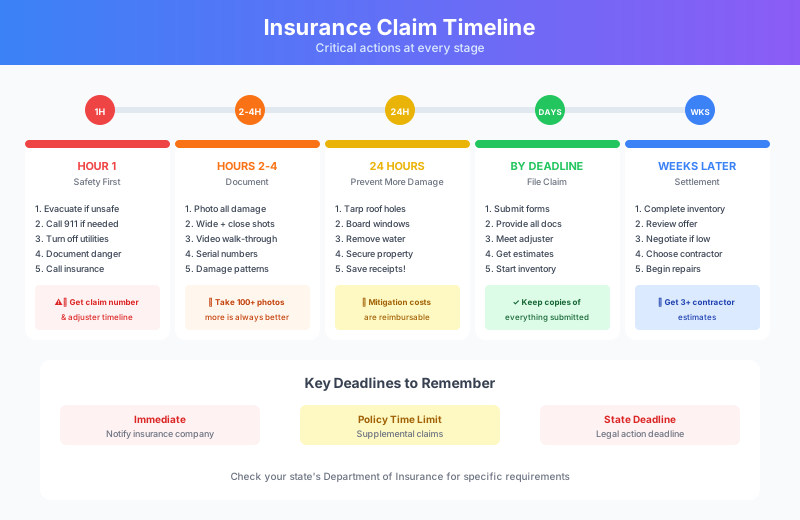
- Read up on claims. If you ever need to file, our step-by-step claims guide walks you through each stage.
The right amount of insurance isn't the cheapest, and it isn't whatever your lender requires. It's enough to rebuild your home and replace its contents at today's prices, plus liability that matches the assets you've worked to build. Spend the ten minutes to get the number right — once a year, every year.