
When a buyer walks through a house, most of what they worry about can't be seen: how old the roof really is, whether the furnace has been serviced, whether the finished basement was permitted. Those unknowns are where offers get softer and inspection negotiations get longer.
A digital home record answers those questions with paperwork instead of reassurances. This guide covers what to gather, how to organize it, how to present it during listing, showings and inspection, and then walks through a worked example so you can see where documentation tends to matter.
A note on the numbers. The worked example below is hypothetical. The house, the prices and the repair estimates are illustrative assumptions chosen to show the mechanics, not results from a real sale. Where this article cites real data, the source is named and linked.
What the Data Actually Says About Selling
A few verifiable facts frame why preparation matters:
- Most transactions involve agents on both sides. In the National Association of Realtors' 2024 Profile of Home Buyers and Sellers, 88% of buyers purchased through an agent and 90% of sellers sold through one. Your documentation will usually be read first by a buyer's agent, who decides how to describe your home to their client.
- Most buyers still get an inspection. NAR's Realtors Confidence Index for December 2025 reported that 18% of buyers waived the inspection contingency, which means the large majority kept the right to inspect and renegotiate.
- Some deals stall or fail. The same NAR survey found that 5% of contracts were terminated and 14% had delayed settlements over the prior three months.
None of this proves that documentation raises a sale price, and you should be skeptical of anyone who quotes a precise "documentation premium." What the data does show is that nearly every sale passes through an agent's review and an inspection, and those are the two points where good records do their work.
Why Documentation Helps: Turning Unknowns Into Facts
Inspectors and buyers can only report what they can observe. When something can't be verified, the safe answer is to flag it:
- "Age of HVAC system unknown. Recommend evaluation by a licensed contractor."
- "Roof age could not be determined."
- "Evidence of renovation. Permit status unknown."
Each of those lines invites a question, and in a negotiation, unanswered questions tend to become credit requests. A buyer who doesn't know whether the furnace is 6 or 20 years old may reasonably price in the worse case.
Documentation doesn't change the condition of your home. It changes how much of that condition the buyer has to guess at. If your systems are older or need work, records won't hide that (and you shouldn't try; disclosure laws apply), but they let everyone negotiate from the same facts.
What to Document Before You List
Work through these categories. Start with the ones marked as high priority; they address the questions that most often come up in inspections.
High Priority: Major Systems
For each system, record the install date, the installer, the warranty terms and any service history.
- HVAC: Install date, model and serial numbers, service invoices, filter-change log, any repairs.
- Roof: Replacement date, contractor invoice, shingle type, manufacturer warranty and whether it transfers, any repair records.
- Water heater: Install date, model, warranty, flush or anode replacement records.
- Electrical: Panel age, any upgrades (with permits), recent electrician work.
- Plumbing: Pipe material if known, repiping or sewer-line work, water treatment equipment.
High Priority: Renovations and Permits
For any significant project, keep:
- The contract or invoice showing scope and cost
- Permit numbers and final inspection sign-offs
- Before, during and after photos (photos of open walls are especially useful)
- Material and product specifications (cabinet maker, countertop material, fixture models)
- Contractor name, license number and contact details
- Any workmanship or product warranties
If you can't find a permit you believe was pulled, your local building department can usually look it up by address. If work was done without a permit, talk to your agent before listing; it's far better to address that early than to have a buyer discover it.
High Priority: Environmental and Safety
- Radon test results and any mitigation system details
- Termite or pest inspections and treatment warranties
- Lead paint or asbestos disclosures where applicable (homes built before 1978 have federal lead disclosure requirements)
- Smoke and carbon monoxide detector replacement dates
- Septic inspections and pumping records, if applicable
- Well water test results, if applicable
Medium Priority: Appliances and Fixtures
- Make, model and serial numbers for kitchen and laundry appliances
- Purchase dates and remaining warranty coverage
- Manuals (PDFs are fine; most manufacturers publish them online)
Medium Priority: Operating Costs
- Twelve to twenty-four months of utility bills, so buyers can see seasonal costs
- Energy audit results, insulation upgrades, or solar production data
- Property tax history and any HOA fees, rules and recent meeting minutes
Nice to Have: Living Details
- Paint colors by room (brand, color name, finish)
- Flooring product information
- Irrigation zones and schedules
- Trash and recycling days, utility providers, and service contacts you'd recommend
- Smart home devices, with a plan for transferring or resetting accounts
How to Organize It
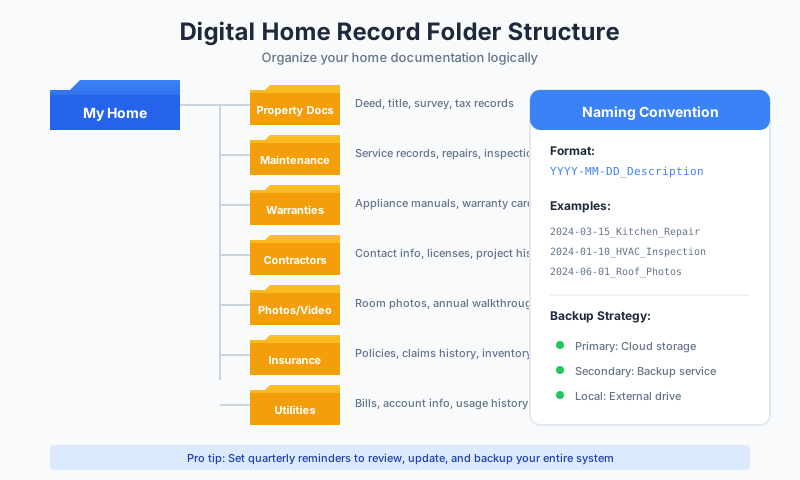
A record is only useful if someone can find what they're looking for in under a minute. Pick a structure and use it everywhere.
A Simple Folder Structure
Home Records - [Address]/
├── 00_Index (one-page summary of systems and ages)
├── 01_Property (deed, survey, tax records, HOA)
├── 02_Renovations/
│   └── [Year]_[Project]/ (contract, permits, photos, specs)
├── 03_Systems/
│   ├── HVAC/
│   ├── Roof/
│   ├── Water_Heater/
│   └── Electrical_Plumbing/
├── 04_Appliances/
├── 05_Maintenance_Log/
├── 06_Utilities/
└── 07_Warranties_Contacts/
Name files with dates first (2023-04-12_HVAC_Service.pdf) so they sort chronologically.
The One-Page Summary
The single most useful document you can create is a one-page summary listing each major system, its age, and where the proof is. Agents can attach it to the listing, and buyers can read it in two minutes. For example:
| System | Installed | Warranty | Last Service | Proof | |--------|-----------|----------|--------------|-------| | Furnace / AC | 2019 | Parts through 2029 | Spring 2026 | 03_Systems/HVAC | | Roof | 2018 | Manufacturer, transferable | Inspected 2025 | 03_Systems/Roof | | Water heater | 2021 | Tank through 2027 | Flushed 2026 | 03_Systems/Water_Heater | | Kitchen remodel | 2022 | Contractor 2-yr (expired) | — | 02_Renovations/2022_Kitchen |
(Values in this table are illustrative.)
Physical, Digital, or Both
- A printed binder works well at showings. Use tabbed dividers that match your folder structure and put the one-page summary first.
- A shared digital folder or platform lets agents forward records to buyers and lets serious buyers review everything before making an offer. Share copies, never originals, and remove anything with account numbers or personal information.
- Both is often the easiest answer: a binder on the counter, with a QR code or link to the full digital set.
A Digital Home Record keeps this organized as you go, so selling becomes a matter of exporting what you already have rather than digging through drawers.
Presenting Documentation to Agents and Buyers
In the Listing
Specifics are more persuasive than adjectives, and they're only possible if you have the records. Compare:
-
Weak: "Updated kitchen."
-
Stronger: "Kitchen remodeled 2022 with permits and final inspection; contractor invoices, product specs and photos available."
-
Weak: "Newer roof."
-
Stronger: "Roof replaced 2018; manufacturer warranty transferable to buyer; invoice and 2025 inspection report available."
Ask your agent to mention in the listing remarks that a documentation package is available. Make sure every claim in the listing is something you can back up with a document.
Briefing Your Agent
Give your agent the one-page summary before the listing goes live, plus a short list of the facts you'd most like buyers to know (system ages, permitted work, transferable warranties). Agents field questions from buyer's agents constantly; the faster they can answer with a document, the better.
At Showings
- Leave the binder in a well-lit, central spot such as the kitchen counter or dining table, opened to the one-page summary.
- Add a small card with a QR code or link to the digital copy.
- Don't include anything you wouldn't want photographed. Assume visitors will take pictures of pages.
Handling the Home Inspection
The inspection is where documentation is most likely to change the conversation.
Before the inspection. Have your agent offer the buyer's inspector the one-page summary and system records. Inspectors still examine everything independently, but they can note documented ages and service history in the report instead of writing "unknown."
During the inspection. Leave the binder accessible and stay out of the way.
After the inspection. When the buyer's repair or credit requests arrive, respond item by item with the relevant records. Some requests will be legitimate. Documentation won't make a real defect go away, but it can answer requests that are based on uncertainty rather than observed problems.
Common examples:
- "HVAC age unknown, may be near end of life." A dated install invoice and recent service record answers this directly.
- "Roof age could not be determined." The replacement invoice and warranty document settle it.
- "Renovation observed, permit status unknown." Permit numbers and final inspection sign-offs address the buyer's concern about future resale or insurance issues.
- "No maintenance history available." A maintenance log, even a simple spreadsheet with receipts, shows how the home was cared for.
A Worked Example (Illustrative)
Here is a hypothetical sale, walked through step by step. Every number is an assumption made for illustration, not data from a real transaction. Prices, repair costs and negotiation outcomes vary widely by market.
The Setup
Assume a 25-year-old, 3-bedroom house listed at $400,000. Over their ownership, the sellers:
- Replaced the furnace and air conditioner in 2019
- Replaced the roof in 2018
- Remodeled the kitchen in 2022 with permits
- Had the HVAC serviced most years
Version A: Records Scattered or Missing
The sellers know all of this, but the paperwork is scattered across email, a filing cabinet and a contractor who has since retired. At inspection:
- The inspector can't confirm the HVAC age from the data plate quickly and writes "age unknown; recommend evaluation."
- The roof shows no obvious problems, but the inspector can't determine its age.
- The kitchen remodel is noted with "permit status unknown."
Suppose the buyer's agent responds with a request for a $9,000 credit: $6,000 toward possible HVAC replacement and $3,000 as a cushion for the roof. (These figures are illustrative. Real requests depend on local costs and the buyer.)
The sellers now have to either accept, counter, or spend time during the inspection response period tracking down invoices and calling the building department for permit records. Each option costs money, time or negotiating goodwill.
Version B: Records Organized Before Listing
Same house, same systems. This time the sellers spent a few weekends before listing gathering and organizing records:
- HVAC install invoice (2019) and service invoices
- Roof replacement invoice (2018) and transferable warranty
- Kitchen permit number and final inspection sign-off
- A one-page summary attached to the listing and shared with the inspector
Now the inspection report reads differently: "HVAC installed 2019 per documentation provided," "Roof replaced 2018 per invoice; manufacturer warranty transferable." The kitchen permit question is already answered.
The buyer might still raise real issues the inspector found, such as a leaking trap under a sink or a missing GFCI outlet. Those are normal and usually inexpensive. But the speculative requests about the HVAC, roof and permits have nothing to stand on.
What the Example Shows
In this illustration, documentation affected three things:
- The size of the credit request. In Version A, $9,000 of the request rested on unknowns. In Version B, that portion is answered by records. How much of it a real seller would keep depends on the market and the buyer.
- Time. Inspection response windows are short, often a matter of days. Finding records during that window is stressful and sometimes impossible.
- Tone. A negotiation based on documented facts tends to be less adversarial than one based on worst-case assumptions.
What the example does not show is a guaranteed higher sale price or a faster sale. Those depend on pricing, condition, location and market conditions. Documentation removes a source of doubt; it doesn't override the market.
What It Cost in the Example
For illustration, assume the sellers spent:
- Roughly 8 to 12 hours gathering and scanning documents
- A small fee to request copies of permit records (often free; varies by municipality)
- $30 to $50 for a binder, dividers and printing
Compare that, for your own situation, with the size of the inspection credits buyers commonly request in your market. Your agent can tell you what's typical locally.
A Pre-Listing Documentation Timeline
Three to Six Months Before Listing
- [ ] Gather everything you have: receipts, invoices, warranties, permits, manuals
- [ ] List what's missing and request copies (contractors, manufacturers, building department)
- [ ] Photograph every room and every major system, including data plates with model and serial numbers
- [ ] Consider a pre-listing inspection so you learn about issues on your own timeline
One to Two Months Before Listing
- [ ] Organize everything into your folder structure
- [ ] Write the one-page system summary
- [ ] Collect 12 to 24 months of utility bills
- [ ] Confirm which warranties transfer and what the transfer process is
At Listing
- [ ] Give your agent the summary and the full digital set
- [ ] Prepare the showing binder
- [ ] Remove personal and financial information from anything you share
- [ ] Make sure listing claims match what your documents support
At Closing
- [ ] Hand over manuals, warranty information, service contacts and the maintenance log
- [ ] Complete any warranty transfers
- [ ] Transfer or reset smart home accounts
Handing the buyer a complete record at closing costs you nothing and gives them a head start on maintaining the home.
Frequently Asked Questions
Q: Will documentation increase my sale price?
A: There's no reliable figure for that, and you should be wary of anyone who quotes one. Sale price depends mostly on location, condition, pricing and market conditions. What documentation can do is answer questions that would otherwise become reasons for lower offers or credit requests.
Q: What if I've lost records for older work?
A: Start with what you can recover. Contractors and manufacturers often keep invoices and warranty registrations, banks and credit card companies keep transaction histories, and building departments keep permit records. For anything you truly can't document, a dated photo of the equipment's data plate often shows the manufacture date.
Q: Should I share documentation that shows problems?
A: Follow your state's disclosure laws and your agent's advice. Known material defects generally must be disclosed whether or not you have paperwork. Records showing that a past problem was properly repaired, such as a roof leak fixed with an invoice and warranty, are usually more reassuring to a buyer than silence.
Q: Is a pre-listing inspection worth it?
A: It can be, particularly for older homes. It lets you find and fix issues (or price them in) before a buyer's inspector finds them under a deadline. Ask your agent whether it's common in your market and how the report would need to be disclosed.
Q: How far back should records go?
A: For major systems and renovations, as far back as you have them. For routine maintenance, the last several years is usually enough to show a pattern of care.
Q: What should I leave out?
A: Account numbers, Social Security numbers, insurance policy numbers, security codes and anything else personal. Share copies, never originals.
The Bottom Line
Buyers, their agents and their inspectors all make decisions based on what they can verify. A well-organized home record turns "unknown" into a date, an invoice and a warranty. That won't sell a house on its own, but it removes the guesswork that tends to work against sellers at inspection time.
The easiest way to have records ready when you sell is to keep them as you go. Our guide to preparing your home for sale covers the rest of the pre-listing process, and the home documentation guide explains how to build a record from scratch.
Learn more about the Digital Home Record →
Related Articles
- The Complete Guide to a Digital Home Record: What a home record includes and how to set one up
- The Ultimate Home Maintenance Schedule: Keep a maintenance log buyers can trust
- How to Document Your Home for Insurance Claims: The same records protect you before you sell
- Free Checklists and Templates: Printable documentation checklists
Sources: National Association of Realtors, 2024 Profile of Home Buyers and Sellers highlights; National Association of Realtors, Realtors Confidence Index, December 2025. The worked example is hypothetical and its figures are illustrative.